Corrections are very welcome, above all from native speakers. If a
definition, example, translation, form, stress mark or recording is wrong,
the fix goes into the next version.
What's new
1.7.1 · 18 October 2026
Fixed from players' reports: clearer definitions for riešutas,
bandyti, atiduoti and manyti; prašau answers
“please; here you are; you are welcome”, the three uses its cards ask for;
all of “handed it over” is bold on atiduoti; and the usage note of
sveiki says sveikà with the right stress.
1.7.0 · 18 October 2026
Every recording is new: all 10,386 clips were recorded again at
LIEPA's own pace, speed 1.0, where the old ones were slowed to 1.2 (or, for
about a quarter of them, quietly were not). In Gintaro kelias you now set
how fast definitions and example sentences play, each on its own dial from
0.8× to 1.4×; a word and its forms play as recorded.
677 new words: 80 from Lūžis, the A1 description, and 597 from Slenkstis, the B1 description (įvairus, duomenys, sritis, tyrimas, atlikti, atvykti…). 36 new usage cards (juk, štai, ei, vaje, apibendrinant, žodžiu…). The deck has 2,567 notes.
1.6.0 · 17 October 2026
105 new words from Slenkstis, the B1 description, each tagged
with its own level. Stress is corrected on ikì and tìk.
The grammar words now have 84 usage cards, 55 of them new: question
words, conjunctions and prepositions (kur, kad, nes, ant, iki, po, už…),
particles, the kaž- and nie- words, and the pronouns, which
were word cards before: joks, koks, toks, kas, kuris, tas, šis, savo,
pats, the possessives mano, tavo, jo, jos, mūsų, jūsų, jų, and
galima, gaila. Tie and šie are shown as the
plurals of tas and šis. A usage card's tip, the case a word
takes or the trap it sets, sits in its own block after the note, and the
gap card keeps the English behind a tap, as word cards do. Usage cards carry
their level too. The deck has 1,856 notes.
1.5.0 · 17 October 2026
Every word now has its level, A1, A2 or B1, from the official
descriptions Lūžis, Pusiaukelė and Slenkstis, and
the most frequent words are marked. New cards come level by level, a few of
one theme at a time, so the everyday words arrive first.
91 new words: 81 from Pusiaukelė's word index that the deck
lacked, and gaila, pernai, užpernai, šįryt, retkarčiais, staiga, pagaliau,
abu, pusantro, meniu. 29 grammar words and set phrases (labas, ačiū,
ir, o, šalia, ar…) get a card of their own kind: how the word is used,
the words it is confused with, and a gap to fill in each example. The deck
has 1,716 notes.
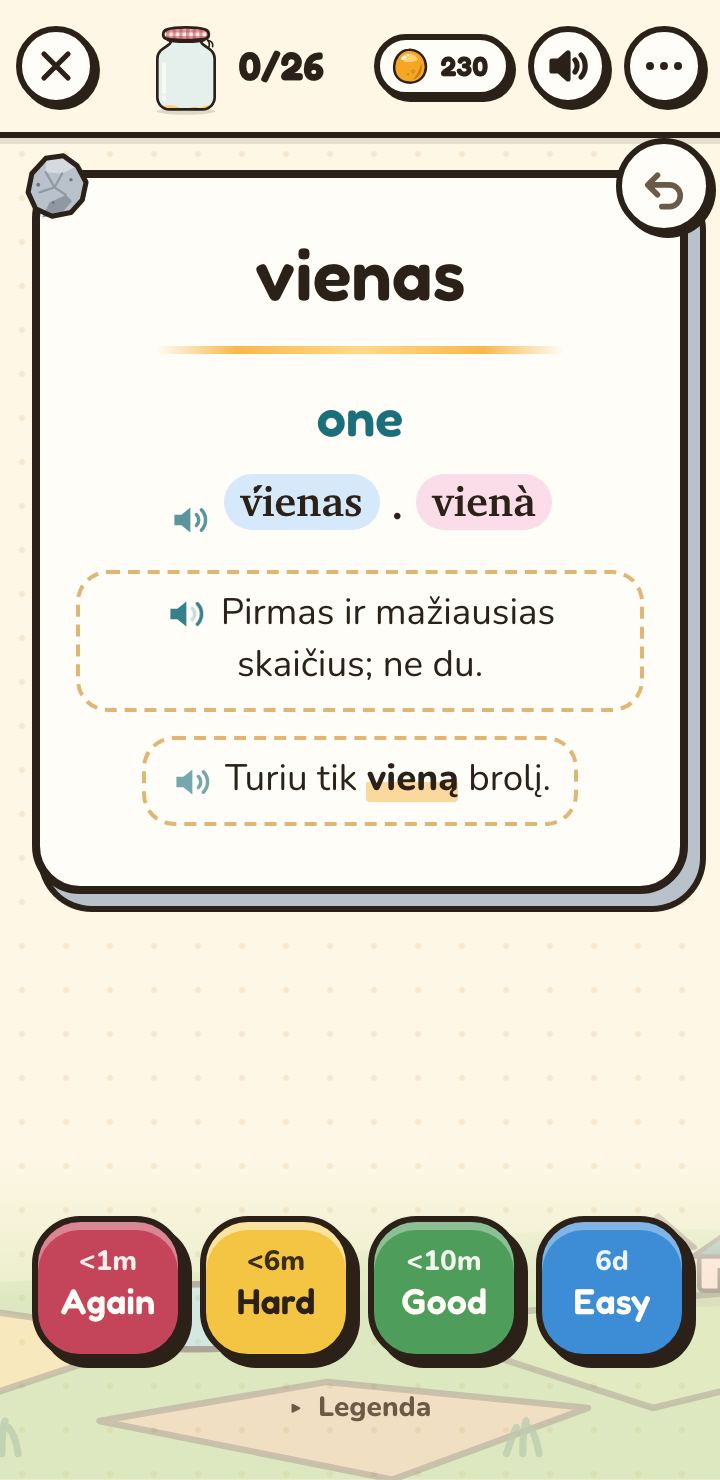
Every stress mark was checked against BLKŽ, the standard
dictionary, and 75 cards are corrected. 166 definitions that described a
thing like a riddle now say first what it is, and are recorded again. The
definition card answers with the Lithuanian word itself, set where the
first card sets the English. The labelled forms sit in coloured bubbles,
with a legend on every back.
1.4.0 · 15 October 2026
Forms are labelled, so a feminine is never read as a plural. An adjective
shows its masculine and feminine one above the other, marked vyr. g.
and mot. g., and so does a noun with a form for each gender:
mókytojas, mókytoja. A noun's singular and plural stay on one
line, marked vns. and dgs.; a noun with one number says so in
the same way: dùrys · tik dgs. Numerals follow the same rules.
Nine feminine cards are merged into their masculine card, which now shows
them: danė, estė, graikė, ispanė, lietuvė, vokietė, čekė, padavėja,
mokytoja. The deck has 1,596 words. Five stress marks no dictionary gave
were chosen by ear, and trys is said once.
1.3.0 · 15 October 2026
Re-recorded clips now reach decks that are already installed. Anki keeps a
media file it already has when an import brings one with the same name, so the
corrected recordings in 1.2.2 never replaced the old ones. A clip's file name
now changes with its recording. Importing this version downloads all the audio
once more.
1.2.2 · 15 October 2026
81 clips re-recorded with the stress the card marks. For a form spelled like
another form of the same word, the synthesiser sometimes stressed the other
one: galvos as the genitive galvõs instead of the plural
gálvos.
1.2.1 · 14 October 2026
33 headword clips re-recorded: said on its own, a word often came out with
an extra soft “a” or “i” after its last consonant. This page moved to
lithuanian.valdas.uk.
1.2.0 · 25 September 2026
9 new words: pats, judėti, šildyti, suaugti, patinas, nustoti, atsistoti,
sužeisti, parašyti. Every stress mark in the hand-checked paradigms was
compared with the Kirčiavimo žodynas at kirtis.info, and 72 were
corrected. praeiti showed another verb's forms; it now shows its own.
1.1.0 · 19 September 2026
3 new words: kvitas, kopėčios, jungiklis.
1.0.0 · 18 September 2026
The first release: 1,593 words in 18 themes, with audio on every card.